


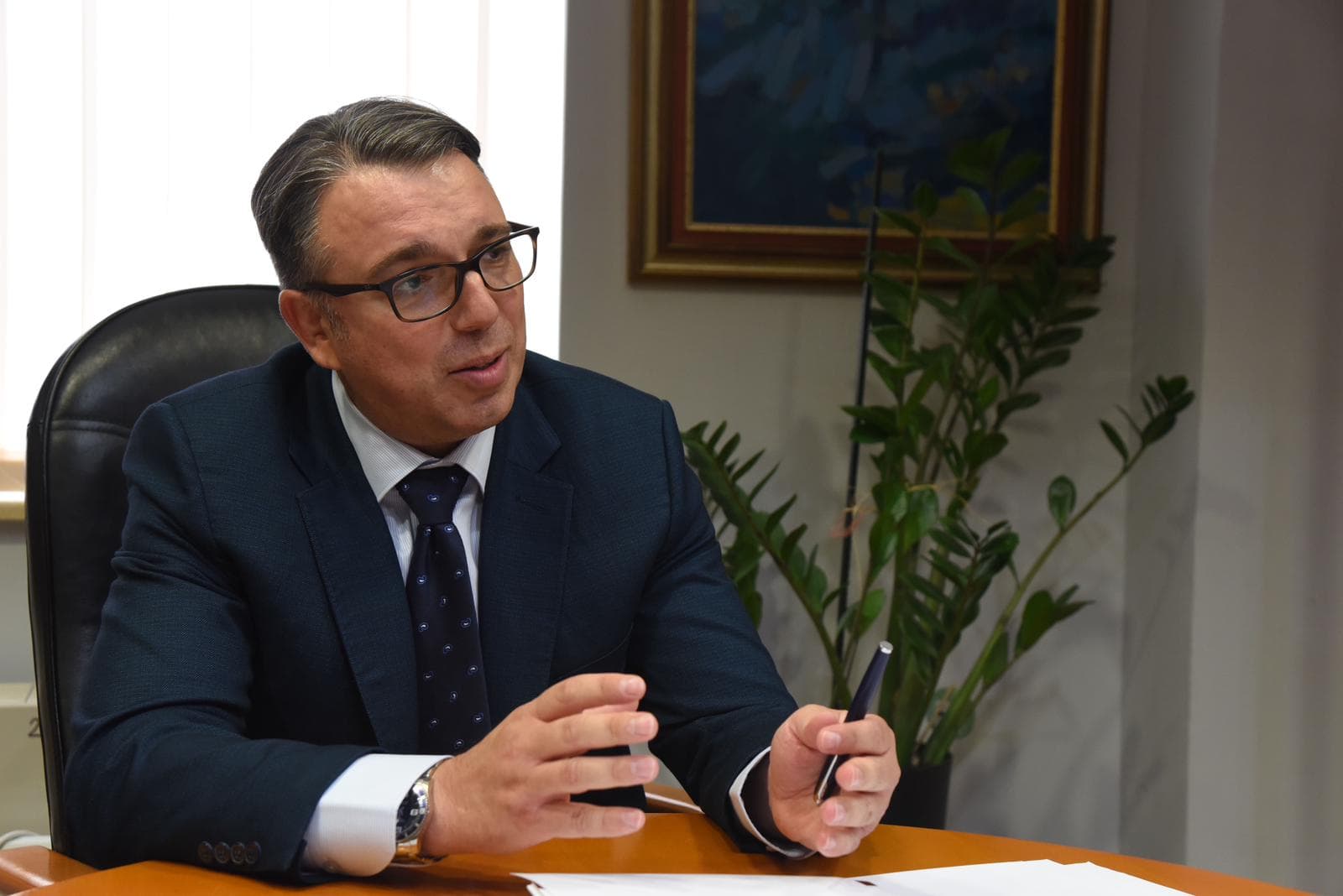
In an interview the Plusinfo, the Minister of Justice Igor Filkov announced that the amendments and additions to the Law on Judicial Council will be adopted by June 2025 at the latest, and the recommendations of the Evaluation Mission will be incorporated into it.
"It is true that the Judicial Council was and still is the subject of public debates and controversies, which reflect the need for reforms in this sphere. Our goal as a state is to provide a strong, independent and functional judiciary, which will not only be independent, but also, accountable to the citizens. The problems you mentioned regarding the functioning of the Judicial Council and its role in distrust of the judiciary are something that cannot be ignored, and they are certainly part of the priorities for the reforms we are planning.
The debate on the immutability and independence of the members of the Judicial Council is complex, because, on the one hand, the independence of judges and members of the Council is key to preventing political influences on the judiciary. But on the other hand, we must not ignore the need to improve the transparency and accountability of these bodies. Although there is concern that changes to the Judicial Council may lead to "political" control over the judiciary, this does not mean that there are no mechanisms to balance this independence with public accountability.
I would disagree with you that the debate is often "opposing views". On the contrary, the public debates held with judges from all four appellate areas, the administrative judiciary and of course the judges from the highest court, the Supreme Court in the country, indicated rather unique views that increased expertise and professionalism of the members of the Judicial Council is necessary, as well as transparency and effectiveness in the procedure for their election, as well as clear bases for their responsibility, while providing appropriate and effective mechanisms for their responsible and efficient functioning. Of course, while maintaining the principle of independence of the judiciary, it is necessary to introduce processes that will enable control over the quality of the work of judges and members of the Council, which will increase the confidence of citizens in the judicial system.
The reforms we are considering are aimed at creating a balance between these aspects – independence and accountability. It is crucial to ensure the status that the Judicial Council is a body that will protect the integrity of judges, but at the same time that it itself is subject to mechanisms of accountability and transparency, which is key to gaining public trust.
I expect that the amendments and additions to the Law on the Judicial Council will be adopted by June 2025 at the latest and that the recommendations of the Evaluation Mission will be incorporated into it", said Filkov.
Regarding the assumption of political responsibility for the situation in the judiciary and the implementation of reforms, Minister Filkov believes that it is necessary to provide mechanisms that will minimize the political abuse of the institutions, and will enable responsibility and at the same time it will protect the independence and integrity of the judges and the judiciary.
"I agree that the elementary principle of expertise, integrity and independence in the election of judges is essential, but, as you noted, the past practice sometimes does not guarantee these qualities. Although contests and general re-elections are mechanisms that should ensure transparency and fair conditions for selection, the fact is that their implementation has not always led to the expected results. We cannot ignore the problems with political influences in these processes, which are factors that compromise the credibility of the judiciary.
But I do not think that this means that we are without a chance for positive changes. The key aspect you raise is the need for accountability. Reforms of the judicial system must be a continuous and systematic process that will not be easy, but at the same time, the political responsibility and engagement of all stakeholders - both the government and the opposition, but also civil society - are key to the success of these reforms. In the end, the responsibility for the situation in the judiciary lies with the institutions themselves, which should work within the framework of the legal order.
The solution lies in providing mechanisms that will minimize political misuse of institutions, while enabling accountability and at the same time protecting the independence and integrity of judges and the judiciary. For that, reforms in the election of judges and members of the Judicial Council should be intensified, stricter criteria for their expertise and integrity should be provided, but also confidence should be built in the institutions with transparency, accountability and clear audit processes.
Reforms do not only mean changing laws, but also changing the culture of institutions. Therefore, they require political courage and political will to take the risks, and at the same time, to provide means and mechanisms for the institutions themselves to work with high standards of independence and responsibility. In these processes, we must not limit ourselves to pointing a finger at one or another power holder as the culprit for the accumulated problems. On the contrary, one should have the virtue and maturity to admit that with certain decisions we have failed to fulfill the purpose for which we serve. A joint action of all stakeholders in justice reform is necessary, regardless of whether it is a court, the Judicial Council, the Council of Public Prosecutors, the Parliament or the Ministry of Justice, because that is the only way we can achieve reforms that will result in success and benefits to us all.
But at the very end, I would like to point out that we cannot achieve this kind of commitment by ourselves as an executive authority. Here, the role of every judge, public prosecutor, member of the Judicial Council and the Council of Public Prosecutors, their dignity and professionalism is crucial", emphasized Filkov in an interview for Plusinfo.