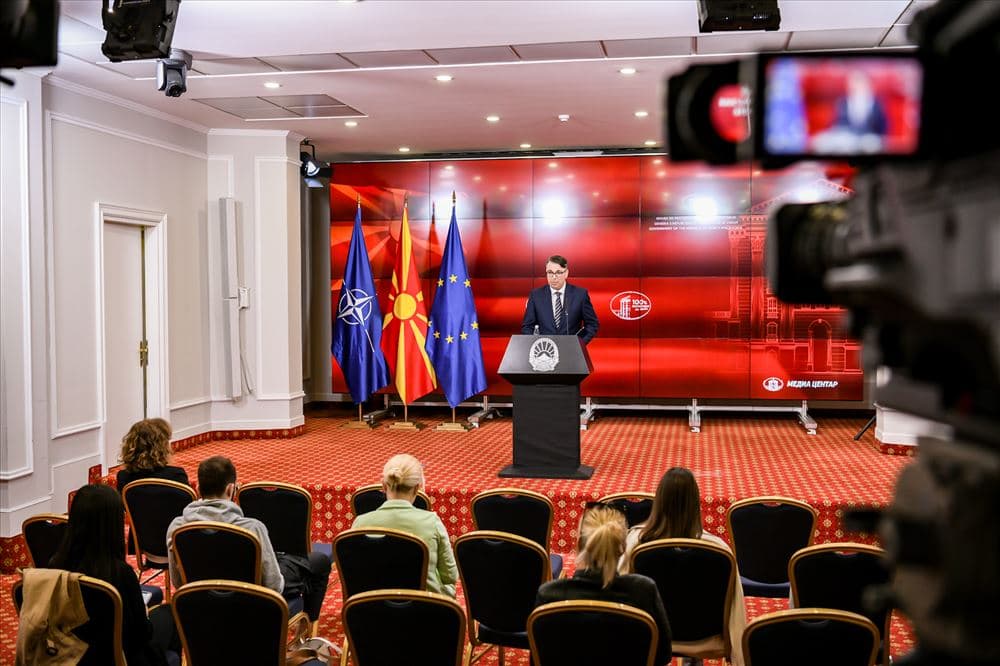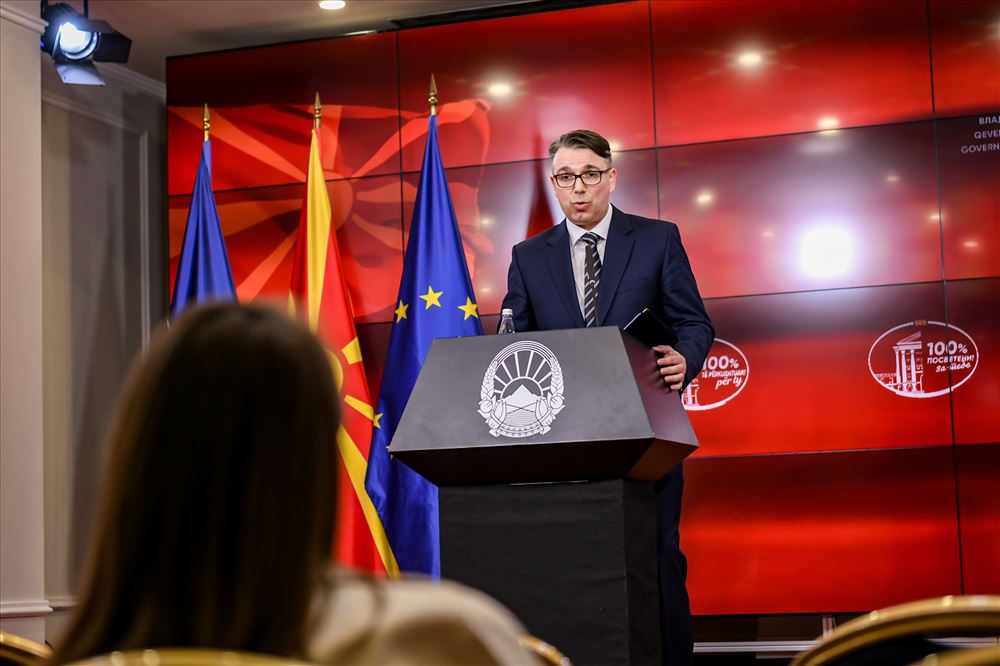
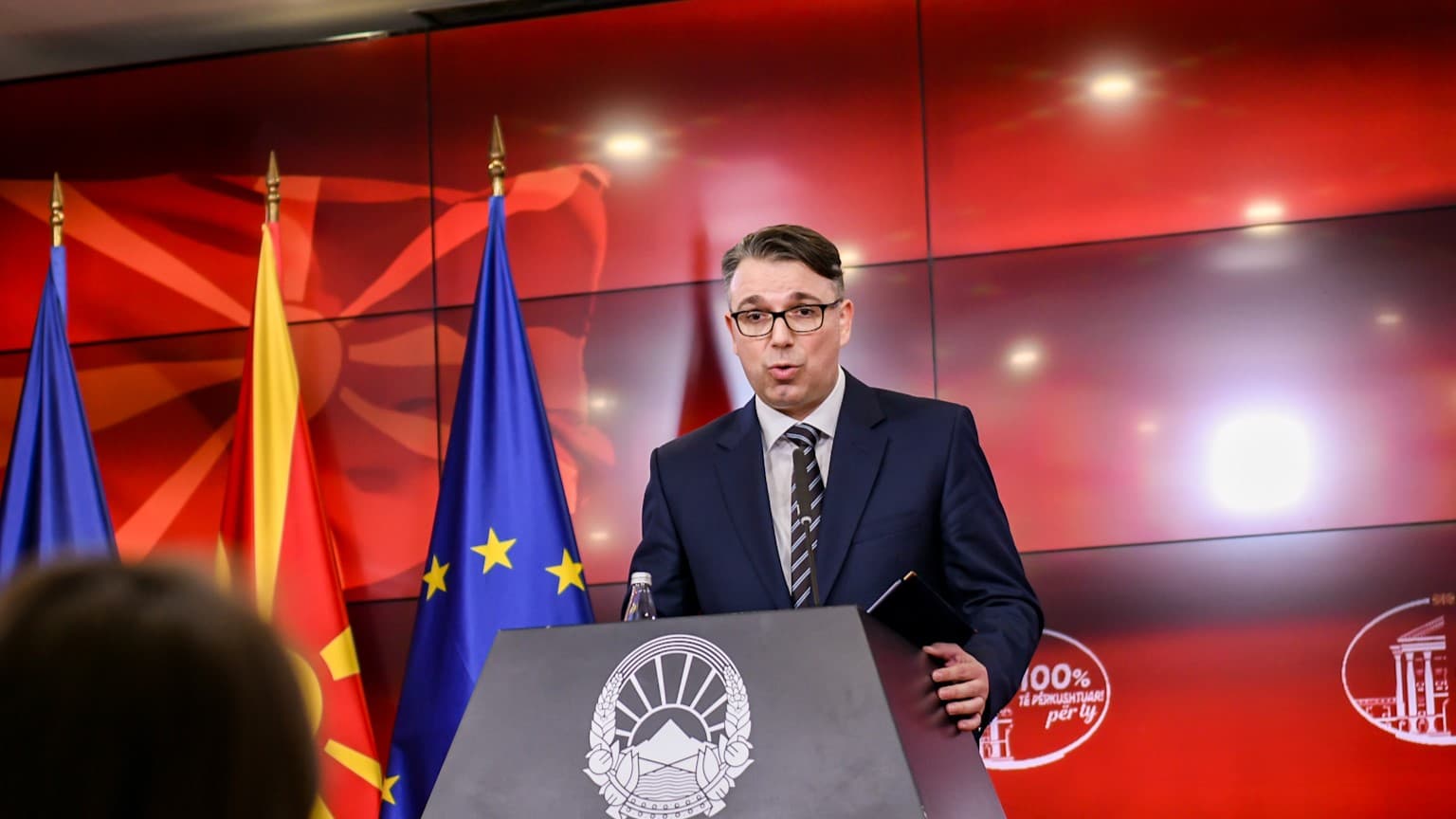
The Minister of Justice, Igor Filkov, held a press conference on the occasion of 100 days of the new Government and he informed about the activities undertaken, the projects that have been implemented, as well as the future priorities of the Ministry of Justice.
Below is the integral address of Minister Filkov:
Dear representatives of the media,
Dear citizens,
As a Minister of Justice, I am pleased to present here before you, the results of the first 100 days of our work.
The Ministry of Justice creates the foundations of the legal system, when taking into consideration all three authorities: legislative, executive and judicial.
Moreover, in the past years, and especially in the past 100 days, the judiciary is the area where the state has received the most criticism. This was followed by comments about increased corruption, especially in judicial institutions.
That is why the expectations of the entire public from this Ministry of Justice are high and rightfully so.
Results are expected, not only because of a change in policies regarding judiciary, but also, every citizen hopes that the proceedings before the courts where they seek protection of their rights, will be legal, without delays, and without any doubt of corrupt influences. Citizens also expect that if such principles of proceedings before the courts are violated, responsibility and measures will follow for the persons who did it. This is the only way to restore public confidence in the judicial system.
Faced with such a challenge, it is easiest to give the answer that time that has passed is too short to see the changes, but the fact is that precisely in this segment, regarding law and justice, so much work is expected to be done.
The path we have taken is not easy. But it is a path we are determined to walk and we will not stop. From the very beginning, this Government has committed itself to deep, substantial and impactful reforms. Citizens in the country deserve a justice system that works for everyone equally, a system that will not be subjected to pressures, influences and corruption.
During the past 100 days, we have laid the foundations of our reform steps aimed at building a transparent and efficient system, in which there will be no place for corruption.
What have we done in 100 days?
- We held over 86 meetings, during which we met with: many ambassadors, representatives of professional Chambers, domestic and foreign experts, civil society organizations, and trade union organizations. Each of the meetings resulted in a new idea, initiative and future collaboration. I can confirm that our relations with international partners have never been stronger. French and other experts are currently working with us in the Ministry of Justice, providing support for the necessary reforms in the judiciary.
- We annulled the previous Government's decision to increase the Notary's tariff tenfold - as a response to the stormy reaction of the citizens, regarding the unjustified excessive increase of the tariff made immediately before the departure of the previous government.
- As a result of the meetings with several trade union organizations, we approached the drafting of a new Law on Judicial Service, considering that for essential reforms in the judiciary, it is not enough to focus only on the courts, their status and responsibility. The court system also consists of thousands of employees such as court clerks, persons who perform technical and auxiliary work in the courts, and court police officers without whom the judiciary cannot function. It is from them, and in order to regulate their status, that reforms in the judiciary begin.
- We hold regular working meetings with the Directorate for Enforcement of Sanctions, but at the same time we held a meeting with the directors of prisons where they pointed out the burning problem of the lack of prison police in almost all prison institutions. A problem pointed out by the union organizations of the prison police, looking for urgent solutions, in order to enable the security of the institutions, both from the outside and from the inside. For this purpose, appropriate solutions are being sought and possible solutions are being considered, including the process of taking over employees from the ARM, who are due to retire, into the prison police.
- The international agreement on the exchange of data for the verification of declarations of property status and the Convention of the Council of Europe on access to official documents came into force.
- We have prepared legal amendments to the Law on Free Legal Aid, which the Parliament has already adopted. This has expanded access to justice for the most vulnerable citizens in our society.
- As a result of the numerous meetings with the expert public, civil and international organizations, we held public debates on the Criminal Procedure Law for further modernization and rationalization of our legal processes, after which it will be released into the government procedure.
- We have approached the end of the decade-long process for the codification of civil legislation. At the request of civil society organizations and the professional public, public debates on the Civil Code are planned in order to present the concept, but also to hear comments and ideas for improving the concept, which aims to increase the legal certainty of citizens.
- We enabled the full implementation of the Femida system - an audio-visual system for recording court hearings that will ensure transparency in court proceedings, before the courts of the entire territory of the country, including the Administrative Court. This system represents a major step forward in ensuring accountability of the judiciary to the public. This was waited for 14 years.
The reforms we have undertaken in these first 100 days have laid the groundwork for deeper, more impactful changes yet to come.
Our vision for the future of justice in North Macedonia is the one where:
- The judiciary is completely independent, free from political influence and accountable to the people it serves.
- Every citizen, regardless of their status or property situation, etc., has equal access to legal representation and a fair trial.
- Every citizen should be assured that corruption in the justice system will be completely eradicated, and those who try to undermine the rule of law will be held accountable.
- In the coming months, we will initiate public debates on legal changes that will be open to suggestions and criticism, especially the debates on the Law on Judicial Council and the Law on Public Prosecution. These discussions will not be superficial. They will be comprehensive, and they will involve all relevant stakeholders and aim to create solutions that will guarantee the independence of these institutions.
- The Judicial Council and the Public Prosecutor's Office must be free from any form of political interference, functioning solely in the service of justice.
- These bodies will be reformed to operate with the utmost integrity, focusing on professionalism and strict adherence to the rule of law.
A major challenge in the realization of this activity is the fact that the Ministry of Justice does not have the aforementioned document with the recommendations of the evaluation mission of the European Commission in relation to the Judicial Council. Although this document is classified information, it was taken by my predecessor, which is why the Ministry of Justice does not have it. As a result, we are forced to rely on electronic versions of only a part of the document, which contains only the recommendations, without the corresponding explanations and the official letter of the EC.
This is only a small part of the announced activities that will be managed by the Ministry of Justice in the next period. Substantial changes are expected to be done in:
- the sphere of the Notary in order to respond to the current needs of the citizens, the economy and notary offices;
- the sphere of Enforcement, where the process of compliance with the new law on payment services, overcoming the problem with the enforcement of future constructions, the creation of functional enforcement offices and more are expected;
- the sphere of Mediation in the direction of creating a functional body for licensing and supervision of mediators and intensifying mediation procedures;
- the sphere of Free Legal Aid with the goal of access to justice for everyone, including asylum seekers, refugees and other vulnerable categories of persons.
In order to enable efficient operation and timely resolution of cases, we are planning to approach legal changes regarding the retirement limit of judges and public prosecutors because we have a constant reduction in the number that is reflected in the handling of cases and the preparation of high-quality decisions.
Dear All,
We have a lot of work ahead of us. It won't be easy. The reform of a complex system like the judiciary requires persistence, courage and support from all sectors of society. But we are ready, though:
- I took over the Ministry of Justice in an unusual way - without a handover from my predecessor and the cabinet was completely empty of the necessary documentation, but full of newly acquired: umbrellas, t-shirts, bags, cups and other items, each in the amount of over 200 pieces, and an unpaid invoice of 956,000 MKD for the supplier thereof;
- I found financial resources seriously depleted;
- non-existence of records of receipt for usage of mobile phone devices, laptops, electric scooters and the like, by the mobile provider, which indicates the personalization of my predecessor with the institution of the Ministry of Justice;
- non-functional vehicle fleet;
- and I can freely say that the functionality of the Ministry has been devastated.
Namely, I found completely empty regional departments of the Ministry of Justice in Skopje, in central and eastern Macedonia and numerous unprocessed cases for BPP, poor and inadequate working conditions. In contrast, the regional departments of the Ministry of Justice in other cities have dozens of employees and a minor number of BPP cases.
This indicates extreme irrationality in the creation of employment policy in the Ministry, which seriously violates the entire concept of BPP in the country. This situation has also been confirmed by the Council of Europe and urgent steps are expected to overcome the problems with the lack of employees for BPP.
In these 100 days we have proven that change is not only possible but is already underway. The projects we initiated will continue, and their impact will only become stronger.
I invite all of you, citizens, to join us on this journey. Together, we can build a justice system that is worthy of citizens, a system that upholds the rule of law, serves with integrity and operates with full transparency.
Thank you for your attention!